
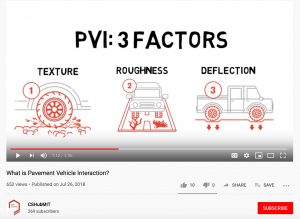
 Click to go to CSHub MIT VIDEO
“What is Pavement Vehicle Interaction?”
… Dr. Mehdi Akbarian, Postdoctoral Researcher-MIT CSHub
explains PVI and some of CSHub‘s recent case studies:
https://www.youtube.com/watch?v=7Z9ldFv5hUw
A Federal Highway Administration (FHWA) technical review panel (TRP)* is studying various Pavement-Vehicle Interaction (PVI)** models (see video link above)—including two from MIT Concrete Sustainability Hub (CSHub) CSHubMIT—to assess the roles the models can play in determining vehicle operating costs and evaluating excess fuel consumption based on roadway conditions. The ultimate goal is to improve pavement sustainability.
The video is by Dr. Mehdi Akbarian, Postdoctoral Researcher-MIT CSHub, who explains PVI and some of CSHub’s recent case studies. Road quality impacts the amount of fuel that drivers use and also influences greenhouse gas emissions. PVI is a research concept that looks at the interaction between a vehicle’s tires and the roadway surface on which it is driving. CSHub pavements research focuses on improving structure and design for increased fuel efficiency, lower maintenance costs, and better life cycle planning.
The GOALS—aimed at ultimately influencing factors to improve pavement sustainability:
• Determine the compatibility of PVI models with traditional economic models that agencies use for highway and roadway investment.
• Study and resolve gaps between the PVI and economic models
• Current PVI models available
An initial August 2019 web meeting began with a discussion of both the study and meeting objectives, literature review, and other details. In opening remarks, the panel acknowledged a comment that none of the current PVI models has been perfected to date. Leif Wathne, Executive Vice President-ACPA and Director-ISCP and Jim Mack, Chairman-ACPA and CEMEX, represent the concrete pavement industry on the panel.
Wathne said, “No model is perfect, but that doesn’t mean it’s not useful. These models are context sensitive and there are uncertainties, but there are ways to handle uncertainty. We need to use the models as best we can to inform decision making.”
Mack said awareness about PVI has increased significantly and adds this has become an increasingly important sustainability factor to the roadbuilding community. “The roadbuilding community has gained a greater understanding and appreciation for the value of PVI modeling than when the industry and MIT first presented it in 2012. Today PVI is widely seen as an important use-phase sustainability benefit, and in fact is one of the major factors in use-phase sustainability consideration. Use-phase benefits are often significantly more impactful than other environmental factors such recycling and reuse, particularly for heavily trafficked corridors. None of this would have likely happened had the cement and concrete industry not invested in itself to research, advocate and support PVI and other sustainability research and technology.”
The work of the TRP is particularly important because of the current situation with limited funding, which impacts everything from research to staffing among agencies.
“We’re currently in a period of constrained resources and yet, industry is being asked to address issues that we’ve never had to deal with in the past.” Mack points to the ACPA VISION2040 (ISCP article: “VISION2040 is a Must-Read & Captures the Future of Concrete Paving”) initiative, which is looking closely at disruptors such as driverless vehicles, in-road magnetic induction, smart highways/roadways and other technologies that will increasingly affect how infrastructure investment decisions are made by agencies.
Mack added, “PVI goes far beyond traditional cost factors and pavement type selection decisions used historically. This initiative is really about improving the quality of information needed to make the best and most-informed decisions possible. This is not just about fine-tuning the approach to cost and pavement-type selection and in fact, decisions among highway and roadbuilding agencies will increasingly be made long before pavement type is considered.”
“As we look ahead, industry will continue efforts to learn more about PVI and its role in highway construction and continue supporting our agencies with solutions that offer exceptional performance, longevity and value, and of course, sustainability benefits,” Jim Mack said.
_________________________
* The TRP is being led and facilitated by the FHWA’s Turner-Fairbank Highway Research Center, Engineering & Software Consultants, Inc, The Transtec Group, Inc. The TRP is comprised of three state highway agency officials, two members of academia, representatives of Argonne National Laboratory and the National Institute of Standards and Technology, and representatives from the concrete and asphalt pavement industries.
** PVI is a concept that looks at the interaction between a vehicle’s tires and the roadway surface on which it is driving, according to MIT, which adds, it is also known as rolling resistance.