
STUDENT SPOTLIGHT: Each month, or every other month, a student will provide a 1-page illustrated abstract of the research they are currently conducting. This is a wonderful opportunity for the student, for our International Society for Concrete Pavements (ISCP) Members, and for the transferring and sharing technology/research through our concrete paving industry.
The ISCP “STUDENT RESEARCH SPOTLIGHT” for September 2026 is Marta Ricci, a Ph.D. candidate in the Department of Environmental and Resource Engineering at the Technical University of Denmark (Denmark), supervised by Associate Professor Asmus Skar Christiansen.

BIO:
Marta Ricci’s research focuses on pavement and geotechnical engineering, particularly on the development of modern sensing technologies through large-scale experimental testing and numerical modelling. Alongside her career as a researcher and engineer, Marta is a former professional fencing athlete, having won 4 medals at European Championships and 11 medals at World Cups. She was recognized as one of the best student-athletes by the Italian Fencing Federation in a ceremony held at the Italian Parliament.
Numerical and Experimental Investigation of Plate Constructions Utilizing Distributed Fiber-Optic Sensing
Conventional monitoring methods for rigid pavements are point-based and often require operational disruption. Distributed fiber-optic sensing (DFOS) offers a promising alternative, enabling continuous strain measurement at high resolution without disrupting operations. Installable either pre- or post-construction, DFOS holds strong potential for structural health monitoring and design validation.
This study aimed to develop a post-construction DFOS installation method and a corresponding finite element (FE) model of the pavement system. Together, the strain measurements and the model enable back-calculation of foundation support and joint characteristics, offering a new approach to pavement monitoring.
A large-scale load test was conducted on an existing rigid pavement test section at Copenhagen Airport, covering 60 m × 15 m across 36 concrete slabs (5 m × 5 m, 360 mm thick) cast from three mixes: standard PCC (REF), calcined clay (FUT), and rapid cement with fly ash (RAFA) (Figure 1).
Two fiber-optic cables were bonded to the pavement surface with epoxy and superglue (Figure 2): a 15 m cable (DOFS#1) ran transversely across two construction joints, while an 8.25 m cable (DOFS#2) crossed a contraction joint and terminated in a loop. The cables were connected to a Luna OBR 4600 optical backscatter reflectometer to record load-induced strains. Loads were applied with a truck positioned at slab centers, near joints, and near free edges (Figure 3). Some data quality issues arose from sub-optimal analyzer operating temperatures and viscoelastic behavior of the bonding adhesive.
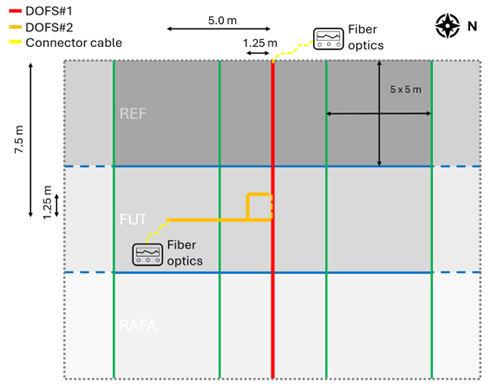
Figure 1. Layout of the test area and routing of the two DFOS cables — DOFS#1 (red) and DOFS#2 (orange) — across the REF, FUT and RAFA concrete mix sections. Construction joints in blue; contraction joints in green.
Figure 2. Bonding of a DFOS cable to the pavement surface using epoxy. | Figure 3. The truck used to apply the loads at the Copenhagen Airport test section. |
The pavement geometry, soil-slab interaction, and joint behavior were replicated in an Abaqus FE model, in which subgrade support was represented through a Winkler foundation. Despite the measurement issues, the model reproduced the measured strain profiles well, and the chosen cable configuration proved particularly suited for back-calculating the Winkler foundation modulus and joint stiffnesses — confirming the technology’s ability to estimate parameters essential to pavement design and service-life assessment.
To scale up this monitoring technology, future work should address the bonding and temperature limitations observed in this study. Embedding the cables within sealed grooves, rather than bonding them directly to the pavement surface, could provide a more durable installation method, well suited to long-term monitoring of existing operating aprons under aircraft loading.
ISCP would like to feature a “STUDENT RESEARCH SPOTLIGHT” each month, or every other month. If you would like to nominate a student, or if you are a student and would like to nominate yourself or a colleague, please send ISCP an email to: newsletter@concretepavements.org